
Have you ever bought the outdoor rug, added the pillows, brought home a few planters and stood back expecting your patio to suddenly look amazing, only to wonder why it still feels slightly unfinished?
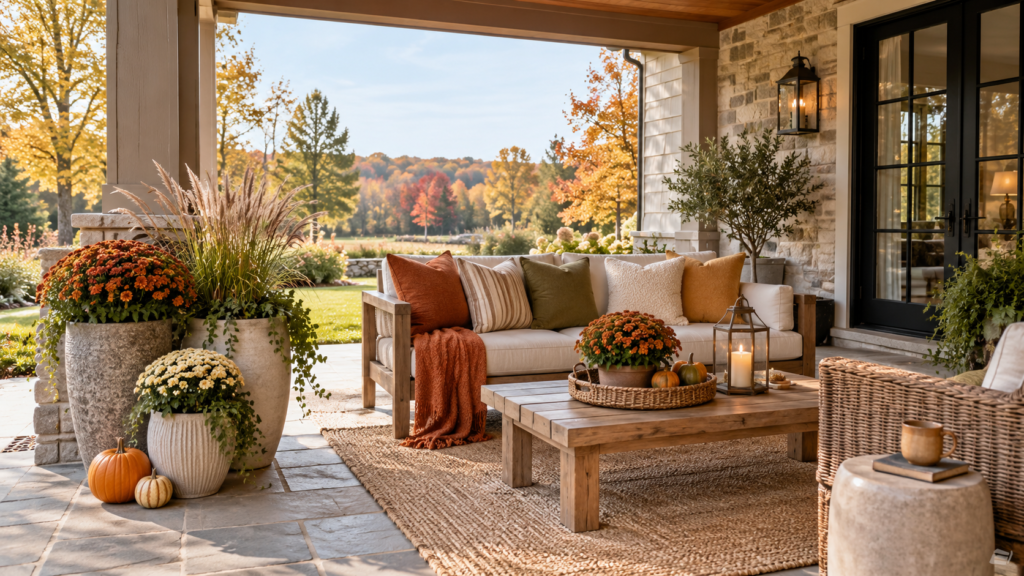
You probably don’t need more decor. You may simply need a better way to arrange what you already have.
That’s where the 3-5-7 rule in decorating can be surprisingly useful. This simple styling idea uses odd-numbered groupings, particularly three, five and seven, to help arrangements feel more relaxed, interesting and intentional.
Most examples of the rule focus on mantels, shelves and indoor coffee tables. But the same principle works beautifully outside, from a trio of planters beside the porch to the pillows on an outdoor sofa.
For Patio & Porch, we’re taking the idea one step further and adapting it specifically for outdoor living.
3 = Create the focal point.
5 = Build the layer.
7 = Complete the outdoor room.
And before you buy anything, remember three more words:
COUNT → VARY → CONNECT
Count the pieces in the grouping. Vary their height, scale, shape or texture. Connect them through color, material or style.
That is often the difference between outdoor decor that simply occupies space and an outdoor area that feels beautifully styled.
This post may contain affiliate links. As an Amazon Associate I earn from qualifying purchases at no extra cost to you.
What Is the 3-5-7 Rule in Decorating?
The 3-5-7 rule is a styling guideline based on arranging decorative elements in odd-numbered groups. While a trio handles smaller vignettes, expanding to five or seven allows you to style larger surfaces and anchor full outdoor zones without losing balance.
The important word here is guideline.
You do not need three of everything. You certainly don’t need seven decorations piled onto every table, and there is nothing wrong with symmetry when symmetry suits the space.
Instead, think of 3-5-7 as a starting point when something feels scattered, flat or unfinished. Three pieces can create a clear little composition, five give you more opportunity for height and layering, and seven can work across a larger area where three small objects might disappear.
Adapting the Formula for Outdoor Living
When we take the principle outdoors, it becomes even more useful because a patio isn’t just one surface. You may be arranging planters, furniture, cushions, lighting, rugs and accessories at the same time.
Rather than counting every item in the entire space, break the patio into smaller visual areas. Think about the corner beside the sofa, the coffee table, the area around the front door, the outdoor dining table or the steps leading onto the deck.
Each can become its own little composition. That’s why our outdoor approach begins with small, three-piece compositions.
Creating the Focal Point with Trios
Three is the easiest number to use and often all you need. One of the best outdoor examples is a group of planters.
Imagine an empty corner beside your patio doors. Instead of lining up three identical little flowerpots, place one taller planter toward the back, a medium planter slightly forward and a smaller, wider pot beside it.
Perhaps all three are warm terracotta. Or perhaps they’re different pots, but each contains pops of white flowers and fresh green foliage.
Now the eye doesn’t see three unrelated pots. It sees a composition. The different heights keep the grouping interesting while the repeated color, material or planting connects everything. Try the same approach with three lanterns, three decorative containers or three objects on a generous outdoor coffee table.
Don’t assume “group of three” means “buy three matching things.”
Matching pieces create repetition. Coordinating pieces create layering. Both can work, but if you’re trying to achieve a relaxed, collected outdoor look, vary at least one element such as height, shape, texture or scale.
Make Outdoor Furniture Feel Connected with Three Part Vignettes
The rule works with furniture too. Two lounge chairs and a small table between them already create a three-part composition.
Now add one beautiful planter slightly behind the chairs and perhaps a cordless outdoor lamp on the table. You haven’t filled every corner. You’ve simply created relationships between the things already there.
Two comfortable chairs are angled slightly toward one another rather than pushed flat against a wall. A round table sits between them. A small rechargeable lamp adds height to the table, while a leafy planter softens one edge.
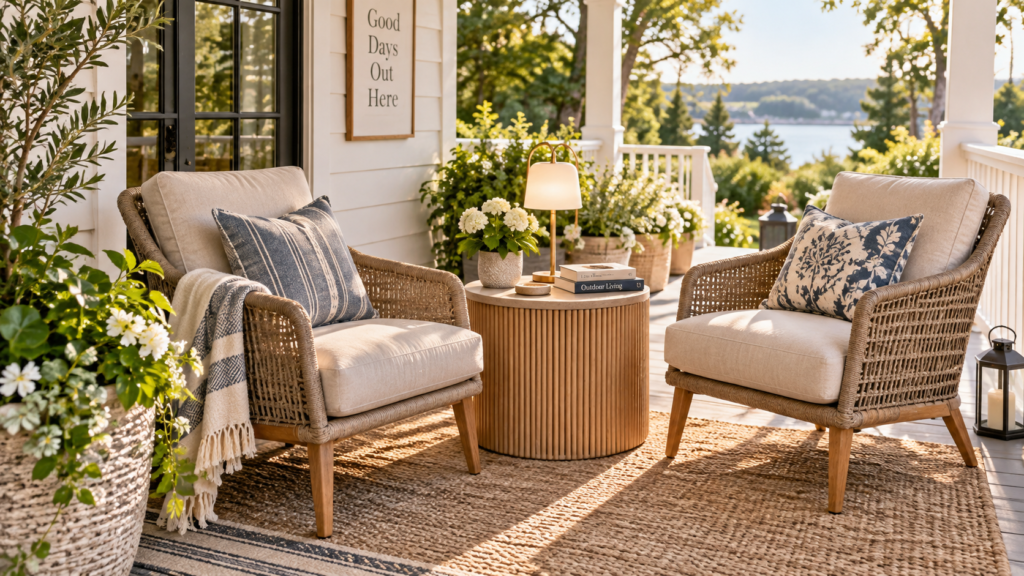
The arrangement feels welcoming because it looks like somewhere people might actually sit and talk.
That matters. A beautiful patio should never feel as though nobody is allowed to touch it.
Expanding to Larger Groupings
Five becomes useful when three feels too sparse for the scale of the furniture or space. An outdoor sofa is a perfect example.
Rather than collecting five unrelated pillows, think about them as a coordinated group. Perhaps you begin with two larger solid-color pillows, add two striped or patterned pillows and finish with one smaller feature cushion in the center.
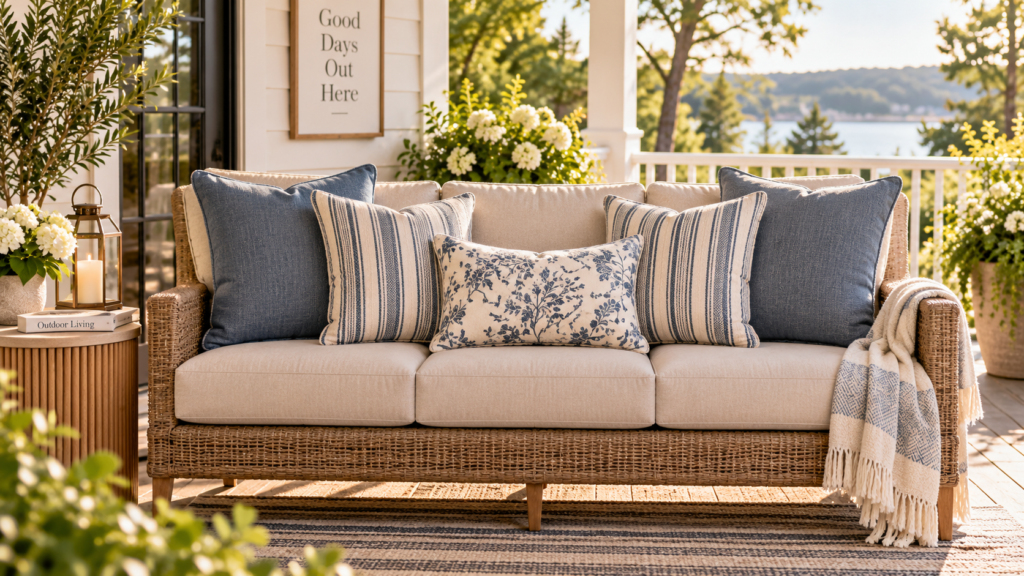
Five pieces, but only three visual ideas. That keeps the arrangement interesting without allowing it to become chaotic. Use repetition to calm a larger grouping.
If you have five accessories, don’t give all five a completely different pattern, color and texture. Choose one star and let everything else support it.
Try the Rule on Your Outdoor Coffee Table
Outdoor coffee tables are one of the easiest places to overdecorate. Before adding anything, remember what the table is for.
People need somewhere to put a drink. They may want to serve snacks, and someone will eventually need to move something.
For a smaller table, three items are usually plenty. Try a low plant, a rechargeable lamp and a decorative bowl or lantern. Vary the heights, vary the shapes and connect them through color or material.
For a larger table, a group of five can work beautifully, particularly when two or three smaller pieces sit together on a tray and visually behave as one arrangement and don’tbe afraid to leave part of the table bare, that empty space is doing work too.
If your beautifully styled outdoor coffee table becomes irritating every time somebody wants somewhere to put a glass, it isn’t beautifully styled anymore, it’s just in the way.
Use 7 for Expansive Groupings
This is where the framework is easily misunderstood: you don’t need seven ornaments cluttering your patio.
Instead, view seven as a macro lens for the whole space—a way to layer an outdoor area so it functions and feels like a complete room:
- Comfortable seating
- A table or useful surface
- An outdoor rug or another visual anchor
- Plants or greenery
- Lighting
- Textiles such as cushions
- One statement element
The statement piece might be a beautiful umbrella, an over-sized planter, a fireplace, a water feature or even the view itself.
This isn’t the textbook version of the 3-5-7, it is our Patio & Porch way of applying the principle to an entire outdoor room.
And it works because it moves your attention away from buying lots of little accessories and toward creating a complete comfortable and beautiful space that you want to sit in.
Current Outdoor Trends That Make Styling Easy
One reason this decorating method feels particularly useful right now is that patios are becoming much more layered and personal. Outdoor spaces are increasingly borrowing the comfort and visual detail traditionally associated with interiors, with current design leaning toward interesting textiles, atmospheric lighting, expressive furniture and natural materials.
You don’t need every trend, but several work particularly well with this method of styling.
Stripes
A striped pillow, rug or umbrella introduces pattern without requiring lots of additional decor. Try repeating the stripe, or one of its colors, elsewhere in the space so the eye makes the connection.
Rechargeable Outdoor Lamps
Cordless lamps are one of the easiest ways to make an outdoor seating area feel more finished. They also solve a practical problem because you can place light exactly where you want it without having an outlet nearby.
Sculptural or Over-sized Planters
One substantial planter can provide more impact than a collection of tiny pots. Use one as the anchor and two smaller coordinating pieces to form your group of three.
Woven Texture
Woven lanterns, baskets, furniture and accessories introduce another visual layer without necessarily adding another color. This works especially well when the space already contains strong patterns.
Warm Natural Colors
Terracotta, sun-washed clay, warm wood, earthy greens and richer natural colors can soften an outdoor room and help it feel connected to the surrounding landscape.
The important part is picking one or two ideas that genuinely suit the patio you already have, not buying up every trend at once.
How to Use the Formula on a Small Patio or Balcony
Small outdoor spaces need restraint more than they need decorating tricks. This is where three is often better than seven.
A compact balcony might need only a small table and two chairs. A single group of three planters may provide all the greenery the space needs. Perhaps each chair gets one cushion and the table gets one little rechargeable lamp. Stop there. Do not keep decorating simply because there is technically another square foot available. In a small outdoor space, every item should earn its place.
If something isn’t useful, beautiful or meaningful, ask whether the patio actually needs it.
Don’t Forget Outdoor Lighting
Lighting can use the framework in a slightly different way. Instead of counting three fixtures, think about three levels of light.
Higher lighting might come from a pendant, wall fixture or overhead source. Mid-level lighting can come from a cordless lamp on a table. Low lighting might come from lanterns, pathway lights or discreet landscape lighting. Not only does it create a theme, it offers a charming way to make a space cozy and cohesive.
The result is far more atmospheric than relying on one bright light source, and it makes the patio feel more like somewhere you want to stay after the sun goes down.
When You Should Ignore the 3-5-7 Approach
There are times when even numbers are exactly right.
Two matching planters on either side of a front door can look beautifully balanced. Two identical sconces may suit the architecture perfectly. Two chairs facing one another can create symmetry and calm. And sometimes one enormous, fabulous planter is all a corner needs.
Good design isn’t about following a formula until every patio looks the same. Think of it as a helpful guideline to create a space you love.
Before You Buy Another Piece of Patio Decor, Try This
This may be the most important part of the entire article.
Don’t shop first. Rearrange first.
Take everything off one small area of the patio and put back only three things. Vary their height and look for one visual connection. Stand back. If it still looks too sparse, consider whether mid-sized groupings would better suit the scale. Then move to the next little zone.
You may discover that the thing your patio was missing wasn’t another product at all. It was composition. And if you do discover a genuine gap, perhaps you need a taller planter to complete your trio, a rug to anchor the conversation area or a lamp for the table, now you know exactly what you’re shopping for.
That’s much better than buying random decor and hoping something works.
The 3-5-7 Rule at a Glance
3 = Create the focal point.
Use it for planters, small tabletops, lanterns and compact seating arrangements.
5 = Build the layers.
Use it when a larger sofa, table or display needs more visual depth.
7 = Complete the outdoor room.
Think of the larger ingredients that make the whole space feel intentional rather than seven little objects sitting together. And every time you style a grouping:
COUNT → VARY → CONNECT
Count your pieces. Vary their height, shape, scale or texture. Connect them through color, material or style.
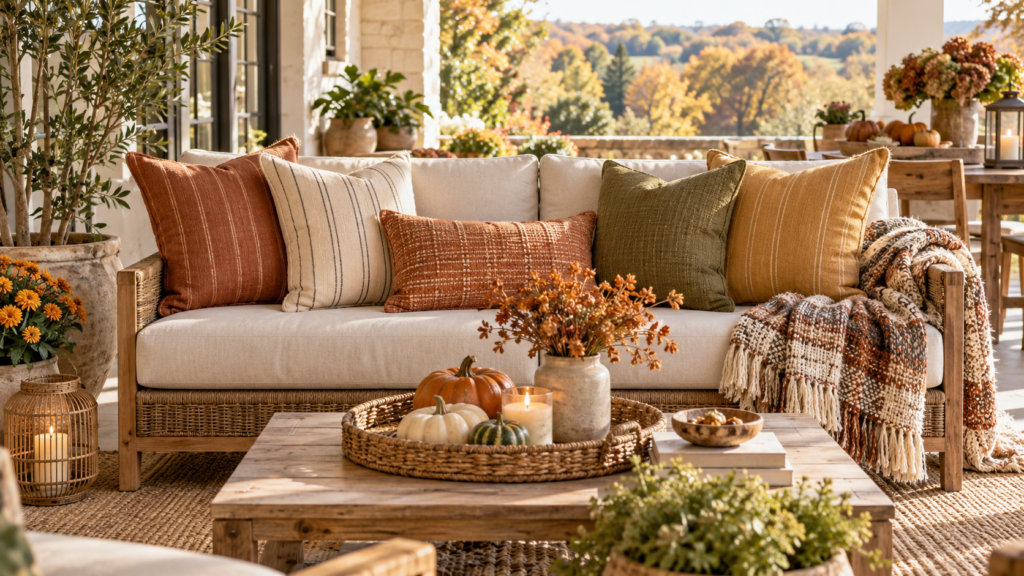
Imagine a bright, sun-filled covered patio styled for Fall in a polished but approachable home and garden editorial style. A comfortable outdoor sofa is layered with five cushions in rust, terracotta, warm cream, olive green, and mustard, with subtle stripes and textured fabrics. That makes a beautifully layered seating area. Beside the sofa, a trio of textured terracotta pots holds soft ornamental grasses, while a low wooden table brings in a touch of warmth. It feels thoughtfully styled, complete, and completely ready for crisp autumn afternoons.
Frequently Asked Questions
Does the 3-5-7 formula work for outdoor decorating?
Yes. The same principle of grouping decorative elements in odd numbers can be applied to planters, lanterns, pillows, tabletop accessories and other patio decor. The key is adapting the number to the scale of the outdoor space.
Are trios or five piece clusters better for patio decor?
Three is usually easier and works especially well on smaller patios and porches. Five can work better on a larger table, sofa or longer area where three items might feel undersized.
Do all three items need to match?
No. In fact, varying height, scale, shape or texture often makes the grouping more interesting. Give the items one connecting element such as color, material or style.
Can I Still Decorate in Pairs?
Absolutely. Paired planters flanking a doorway or matching lanterns on either end of a side table create structure and symmetry. The goal isn’t to banish pairs—it’s simply using odd numbers when you want an arrangement to feel more relaxed.
Creating a thoughtfully styled outdoor space isn’t about buying more decor—it’s simply about giving what you already own a sense of balance, purpose, and room to breathe. Your patio may not need more, It may need better placement.
As an Amazon Associate I earn from qualifying purchases.
